Science
Before product, I was a physicist. I worked on quantum optics: making light that behaves quantum-mechanically even when it contains millions of photons.
From Google Scholar, October 2026.
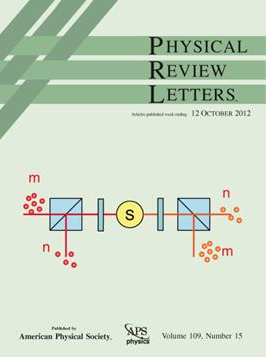
On the cover of Physical Review Letters. Our paper on polarization-entangled light pulses of 100,000 photons made the cover of PRL vol. 109, no. 15 (12 October 2012). It was also an Editors' Suggestion. Read the paper
What I worked on, in plain language
Quantum effects in light, such as entanglement and noise below the classical limit, are usually shown with one or two photons at a time. That makes them fragile and hard to use. My PhD asked whether you can keep those effects in bright pulses of light with millions of photons, which are much easier to detect and to work with.
With Maria Chekhova's group at Moscow State University and Gerd Leuchs at the Max Planck Institute for the Science of Light, we produced "bright squeezed vacuum". This is light from a strongly pumped nonlinear crystal whose two beams are correlated more tightly than classical physics allows. We then made polarization-entangled pulses of more than 100,000 photons, which became the PRL cover paper. That kind of light is a building block for quantum memories and quantum communication.
Before that, in my master's work, I tested the opposite question: how far ordinary light can imitate quantum effects. Working with Ling-An Wu's group in Beijing, we showed that higher-order "ghost imaging" with thermal light gives much clearer images. That paper is my most cited. In Eindhoven I moved to integrated quantum photonics: single-photon detectors and single-photon sources built on semiconductor chips.
Path
- Marie Curie Postdoctoral Fellow, Eindhoven University of Technology, 2013–2014. Integrated quantum photonics in Andrea Fiore's group.
- PhD, Physics, Lomonosov Moscow State University, 2009–2012. Thesis: Macroscopic squeezed vacuum states. Co-organized a conference and made three research visits to Germany.
- MSc, Physics, Lomonosov Moscow State University, 2003–2009. Thesis: Multiphoton interference and ghost imaging with classical light. Research visits to Germany and China, and co-organizer of the university's Optica (OSA) student chapter.
Selected publications
- Iskhakov, Agafonov, Chekhova, Leuchs. Polarization-entangled light pulses of 105 photons. Phys. Rev. Lett. 109, 150502 (2012). Cover article.
- Chen, Agafonov, Luo, Liu, Xian, Chekhova, Wu. High-visibility, high-order lensless ghost imaging with thermal light. Optics Letters 35, 1166 (2010).
- Agafonov, Chekhova, Leuchs. Two-color bright squeezed vacuum. Phys. Rev. A 82, 011801(R) (2010).
- Agafonov, Chekhova, Iskhakov, Penin. High-visibility multiphoton interference of Hanbury Brown–Twiss type for classical light. Phys. Rev. A 77, 053801 (2008).
- Agafonov, Chekhova, Iskhakov, Wu. High-visibility intensity interference and ghost imaging with pseudo-thermal light. J. Mod. Opt. 56, 422 (2009).
Full list on Google Scholar.
Patent
Viscometer, RU 153031 U1 (2015). A low-cost viscometer built on a tuning fork. It measures a liquid's viscosity from how quickly the fork's vibration dies down, using a sample of less than 0.1 ml.
Fellowships and awards
- Marie Curie Fellowship for postdocs, 2013–2014
- Dynasty Foundation support program for PhD students, 2010 and 2012, and for students, 2007
- Special state scholarship of the Government of the Russian Federation for PhD students, 2010
- Grant of Moscow, 2004 and 2005
- LabVIEW student programming competition, 3rd place as team lead of five, 2006
Teaching
Research supervisor and lecturer, Summer Physics Camp for schoolchildren, 2002–2005 (volunteer). I supervised school students' research projects: controlling vortex rings and studying their structure, how vortex rings interact in air, the flight kinematics of bats, and the dynamics of blood clotting. I taught experimental data analysis, experimental technique, measurements in physics and a physics workshop, and helped organize the camp.
What carried over
Physics taught me to model a system before trying to change it and to distrust a number until I know how it was measured. I still use both in product work. Pricing models, forecast pilots and payment reconciliation are all, at bottom, measurement problems.